


Reading the tea leaves
Reading the tea leaves — Ten months ago, we rang in the new year with rose-colored glasses. One lens was optimistically looking at our market; the other was anticipating the upcoming easing cycle. At the time, the market expected six rate cuts in 2024 (totaling 150 basis points (bps)), with five (totaling 125 bps) occurring by October (Figure 1).
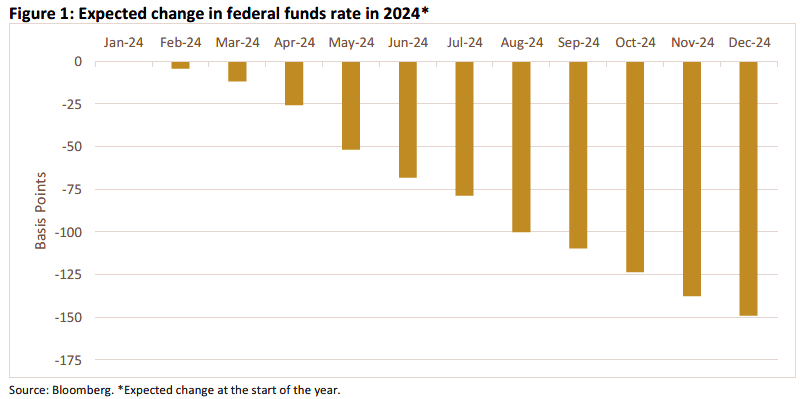
Despite the market’s expectations, officials at the Federal Reserve (Fed) were less committed to aggressive easing as 2024 approached. Consider a few examples.
- Patrick Harker, president of the Philadelphia Fed: “It’s important that we start to move rates down…[but] we don’t have to do it too fast, and we’re not going to do it right away.” (Dec. 20, 2023)
- Raphael Bostic, president of the Atlanta Fed: “I’m thinking inflation is going to come down relatively slowly in the next six months, which means there’s not going to be urgency for us to pull off our restrictive stance.” (Dec. 19, 2023)
- Loretta Mester, president of the Cleveland Fed: “[Markets are] a little bit ahead [of us on rate cuts].” (Dec. 18, 2023)
- Mary Daly, president of the San Francisco Fed, opined that it was too soon to speculate on when cuts might happen in 2024. (Dec. 18, 2023)
- John Williams, president of the New York Fed, also said that it was premature to begin thinking about cutting rates in March 2024. (Dec. 15, 2023)
“Normative” economics is based on opinion, or what ought to be. “Positive” economics is based on facts, or what is. The market evidently had strong opinions on what the Fed should do (normative) entering 2024. Yet Fed officials disagreed with the market’s view and subsequently delivered the first 50 bps cut just a month ago (positive).
The following are some key facts about employment and inflation that the Fed will weigh.
- Job openings have declined since the March 2022 peak of 12 million and are now at eight million. The latter number is still above pre-pandemic highs, but the trend is down.
- Initial claims for unemployment benefits are off the September 2022 low of 187,000 but have been
increasing in a sawtooth pattern since early 2024. Last week’s figure was the highest this year. - Nonfarm payroll growth has slowed. Average job gains, year to date, were 377,000, 251,000, and 200,000 for 2022, 2023, and 2024, respectively.
- Inflation has been declining since June 2022 (albeit more slowly since June 2023). The latest inflation figures, released this past Thursday, were marginally higher than expected, but were largely in line with previous prints.
Here are some key takeaways from the minutes of the Fed’s Sept. 17-18 meeting:
- A “substantial majority” of officials backed the decision to cut interest rates by a half percentage point, but “some” said they would have preferred a quarter-point cut and “a few others indicated that they could have supported” an even smaller move.
- “Almost all” officials agreed that upside risks to inflation had diminished, while downside risks to employment had increased.
- Officials noted, however, “that labor market conditions remained solid, as layoffs had been limited and initial claims for unemployment insurance benefits had stayed low.”
In other words, there was not unanimous support for a 50-bps cut. Since then, economic data has been strong. Perhaps more importantly, Fed officials have made the following comments.
- Austan Goolsbee, president of the Chicago Fed: “The overall trend over 12 to 18 months is clearly that inflation has come down a lot and the job market has cooled to a level which is around where we think full employment is.” (Oct. 10, 2024)
- Raphael Bostic, president of the Atlanta Fed: “I am totally comfortable with skipping a [cut at the next] meeting if the data suggests that’s appropriate.” (Oct. 10, 2024)
- Lorie Logan, president of the Dallas Fed: “Following last month’s half-percentage-point cut in the fed funds rate, a more gradual path back to a normal policy stance will likely be appropriate from here to best balance the risks to our dual-mandate goals.” (Oct. 9, 2024)
- Susan Collins, president of the Boston Fed: “A careful, data-based approach to policy normalization will be appropriate as we balance two-sided risks and remain highly attentive to both parts of our Congressional mandate.” (Oct. 8, 2024)
- Alberto Musalem, president of the St. Louis Fed: “Patience has served the FOMC well in its pursuit of price stability and remains appropriate now, but I will not prejudge the size or timing of future adjustments to policy.” (Oct. 7, 2024)
- Neel Kashkari, president of the Minneapolis Fed: “After 50 basis points, we’re still in a net tight position so I was comfortable taking a larger first step…As we go forward, I expect, on balance, we will probably take smaller steps unless the data changes materially.” (Oct. 7, 2024)
- Both solid economic data and Fed rhetoric may also explain why interest rates have risen in the last week or two and the market has priced in fewer cuts. Indeed, a November and December cut of 25 bps was a sure thing before the latest labor report. Yet the likelihood of one now is just a coin flip. Likewise, a “trough” of 175 bps of cuts has shrunk to one of just under 150 bps (Figure 2).
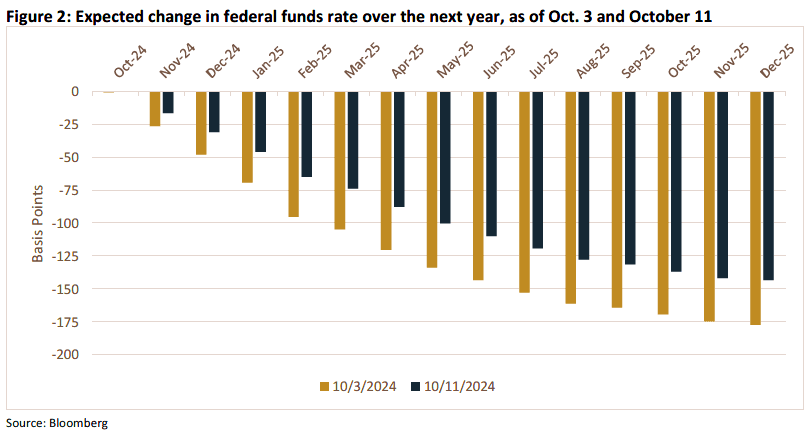
In short, the market got ahead of the Fed at the start of the year (to borrow Loretta Mester’s phrase) and seemingly did so again, up until a week ago. Pricing has now come back in line with the rhetoric of Fed officials: The tea leaves have shifted from aggressive to milder easing.
FROM THE DESK
Agency CMBS — The runup in rates left our market without much to trade. Volumes were light and spreads were largely flat. No major updates, week over week (WoW).
Municipals — AAA tax-exempt yields were higher throughout the yield curve, WoW. After the housing and healthcare sectors were slow two weeks ago, we saw a number of deals price last week in each sector—and at spreads consistent with prior weeks. We expect the next several weeks to remain at elevated issuance levels, with the market then taking a breather around the November election. In previous years with a presidential election, the market saw elevated issuance in October, while November and December saw below-average issuance volume.
Municipal bond funds saw a 14th straight week of inflows last week, with $419 million coming in ($16.32 billion of inflows, year to date). High-yield funds also continued to see inflows, with $308 million coming in last week (24th straight week of inflows).
Economic Calendar for the Week Ahead
| Indicator | Release | Period | Consensus | Prior |
|---|---|---|---|---|
| Empire Manufacturing | 10/15/24 | Oct. | 3.3 | 11.5 |
| Retail Sales Advance, MoM | 10/17/24 | Sep. | 0.3% | 0.1% |
| Retail Sales Control Group | 10/17/24 | Sep. | 0.4% | 0.3% |
| Initial Jobless Claims | 10/17/24 | Oct. 12 | 240k | 258k |
| Continuing Claims | 10/17/24 | Oct. 5 | — | 1,861k |
| Industrial Production, MoM | 10/17/24 | Sep. | -0.1% | 0.8% |
| Capacity Utilization | 10/17/24 | Sep. | 77.8% | 78.0% |
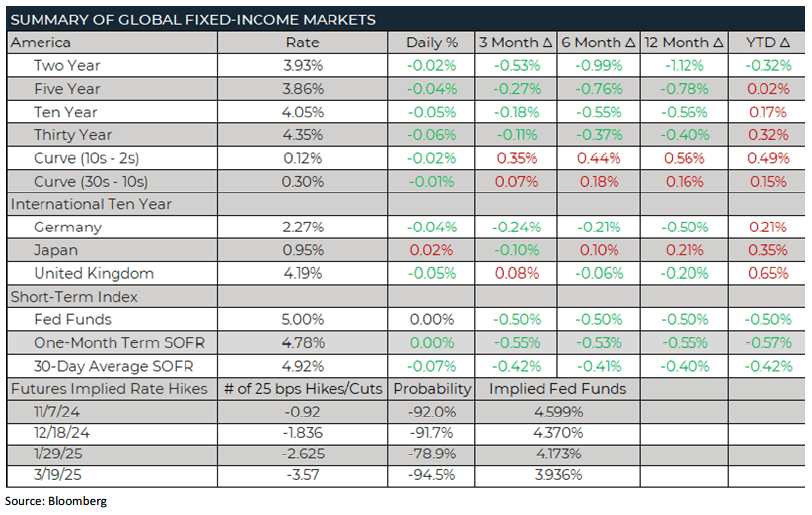
Summary of Global Fixed-Income Markets
The information contained herein, including any expression of opinion, has been obtained from, or is based upon, resources believed to be reliable, but is not guaranteed as to accuracy or completeness. This is not intended to be an offer to buy or sell or a solicitation of an offer to buy or sell securities, if any referred to herein. Lument Securities, LLC may from time to time have a position in one or more of any securities mentioned herein. Lument Securities, LLC or one of its affiliates may from time to time perform investment banking or other business for any company mentioned.



